The MN Service Industry Foundation (MNSIF) is a non-profit organization that supports Minnesota service industry workers that face unexpected financial hardships.
Now is a great time to sign up for our 18 week summer CSA program! We are excited to bring you produce harvested fresh from our farm in Plato, MN – ideal for creating deliciously colorful recipes! We’ve made it convenient by offering over a dozen pick-up locations throughout the Twin Cities. Our shares are available in a variety of sizes – ideal for any household! We also offer additional share add-ons from our local partners, coffee from @kopplins and mushroom shares from @rrcultivation.
Support local agriculture and local businesses (and eat delicious foods!) by signing up for our CSA.
While he was working in Minneapolis on March 31, 2020, Mark Fawcett decided to have a bit of fun and put a mask (a used one, not suitable to donate) on the statue of Mary Tyler Moore, located at the corner of Nicollet Mall and 7th Street. (Courtesy of Mark Fawcett)
As an essential worker, Mark Fawcett was out making tech support house calls on Tuesday when he thought about someone else who might need a little support.
Not someone exactly — instead, an icon set in bronze, a symbol of Minnesota Nice who stands at the corner of Nicollet Mall and 7th Street in downtown Minneapolis: The statue of the late actor Mary Tyler Moore, immortalized as she tosses her hat joyfully in the air, just as she did while playing fictional WJM-TV producer Mary Richards of Minneapolis in the opening montage of “The Mary Tyler Moore Show,” that hit television show from the 1970s.
“Earlier in the day,” said Fawcett, “I thought, ‘I wonder if anyone has put any protective gear on Mary Richards.’ So I decided to swing by and see.”
Mary was there. But: “She was out in the open,” he says, “not protected.’
As the St. Paul man behind Mac Men — a small business that is considered essential, Fawcett is trying to stay safe during house call stops to help people keep their Apple equipment running. This includes keeping his distance, wearing gloves, washing his hands and using his old, repurposed woodworking masks as face masks during the COVID-19 crisis.
“I had been using this mask and these gloves for quite awhile and it was time to dispose of them,” Fawcett said. “I thought it would be fun instead to use them to take care of Mary for the city of Minneapolis.”
(Just to emphasize: Neither the used, non-medical mask nor the worn gloves were suitable to donate to health care workers.)
Passers-by noticed Mary’s new personal protection equipment.
“I saw people stopping to take pictures,” he said. “I heard some chuckles.”
That was his mission, really: “My point for doing this was to bring a smile to people’s faces,” Fawcett says, “or to give people something to chuckle about during this tough time.”
A bicyclist stops to take a photo of the masked Mary Tyler Moore statue in downtown Minneapolis on March 31, 2020. (Courtesy of Mark Fawcett)
Perhaps Mary’s mask — if she’s still wearing it — can also serve as a public service announcement of sorts: The Centers for Disease Control and Prevention is reportedly now considering whether to advise all Americans to wear homemade face masks in public, according to National Public Radio.
As for Mary?
With the help of her mask, Fawcett says, with a nod to her theme song: “She’s going to make it after all,” he says.
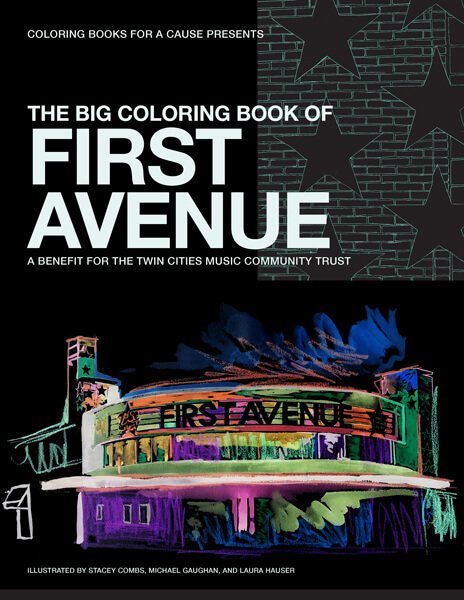
The first coloring book is themed around First Avenue, benefitting and featuring illustrations of local musicians.
The musician Har Mar Superstar (aka Sean Tillman) and Laura Hauser launched Coloring Books For a Cause as a way to support the local community during self-quarantine due to the coronavirus. Tillman, a singer-songwriter, has experienced firsthand the loss of income due to the spread of the virus, and wanted a way to assist people like him during this crisis.
His fiancée, Hauser, was already supporting local musicians. If you bought merchandise or music from a Twin Cities musician and emailed her a receipt, Hause would send you a hand-drawn thank you card of that artist. However, demand for these thank yous became too much, and on a walk together, the two came up with the idea of creating a coloring book that could be sold to aid those put out of work.
The first coloring book supports First Avenue, featuring outlines of local heroes like Lizzo, Prince, Atmosphere, and Dizzy Fae, just to name a few. Not only can this coloring book provide a way to keep you or your kids occupied, it can introduce them to some of the legends that have passed through First Avenue. The Big Coloring Book of First Avenue was illustrated by Stacey Combs, Michael Gaughan, and Hauser.
For each coloring book made, about 60 percent of proceeds will go to the place the book illustrates. Proceeds also benefit the illustrators and go toward providing information on how to support the subjects of individual drawings within the coloring books. For the first iteration, proceeds benefit the Twin Cities Music Community Trust.
The first coloring book can be ordered here. It is expected to ship out April 2.
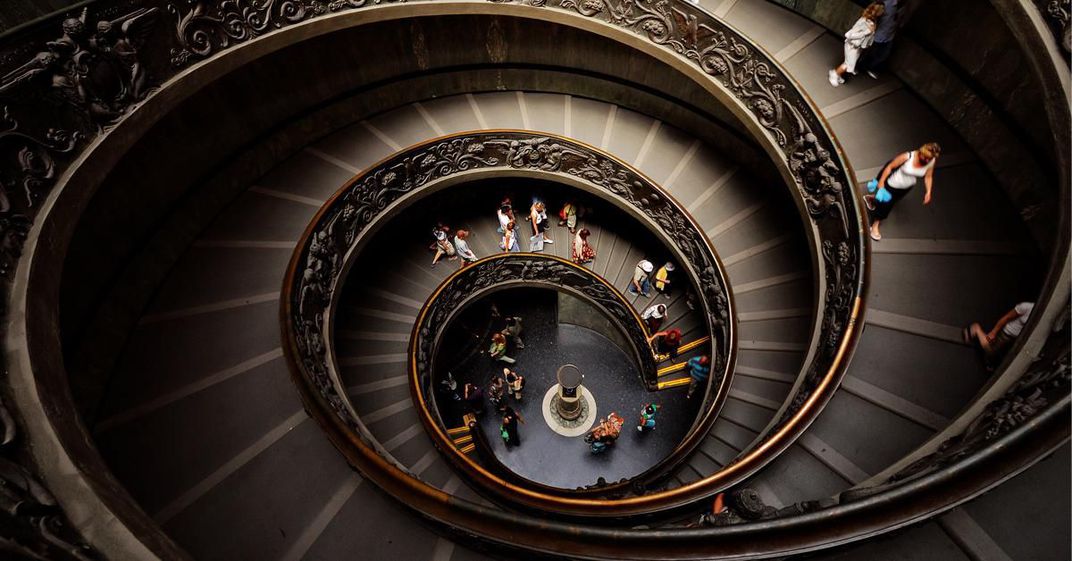
The Vatican Museums (pictured here), the Anne Frank House and the National Museum of Anthropology in Mexico City are among the many cultural institutions with online offerings. (Getty Images)
Museums are closing their doors amid the coronavirus crisis, but many offer digital exhibitions visitors can browse from the comfort of home.
Amid the COVID-19 pandemic, museums and cultural institutions across the globe are closing their doors to the public. But while visitors can no longer roam the halls of these institutions, virtual tools and online experiences mean anyone with an internet connection can browse world-class collections from home.
For those in search of armchair travel inspiration, Smithsonian magazine has compiled a list of ten museums that have found new ways to fulfill their critical mission of cultivating creativity and spreading knowledge.
Home to the world’s second largest private collection of art, the Museo Nacional Thyssen-Bornemisza owns masterpieces by giants of virtually every art movement—to name just a few, Jan van Eyck, Titian, Caravaggio, Rembrandt, Picasso and Dalí. To spotlight these artistic treasures, the Madrid museum offers an array of multimedia resources. Users can take a virtual tour of the entire building (or a thematic tour covering such topics as food, sustainability, fashion and even “inclusive love”); browse current and closed exhibits; and watch behind-the-scenes videos featuring interviews, lectures and technical studies.
The National Museum of Modern and Contemporary Art, Korea
Visitors look at a site-specific art project called Home Within Home by artist Suh Do-Ho during a media event before the opening of a branch of the National Museum of Modern and Contemporary Art, Korea, in Seoul. (Jung Yeon-Je / AFP via Getty Images)
Committed to offering a culturally rewarding experience since opening its doors in 2013, the National Museum of Modern and Contemporary Art in Seoul (MMCA) has established itself as a prominent cultural platform and leader in Korean art. In collaboration with Google Arts and Culture, the MMCA is now offering a virtual tour of its collections. This experience takes visitors through six floors of modern and contemporary art from Korea and around the world. Those seeking an educational walkthrough can follow along by tuning into curator-led recorded tours.
The Anne Frank House, established in cooperation with the famed diarist’s father, Otto, in 1957, strives to inform the public through educational programs and tours of the building where the teenager and her family hid during World War II. To delve deeper into the story detailed in Frank’s diary, online visitors can watch videos about her life; virtually explore the Secret Annex; look around the house where she lived before going into hiding; and view the Google Arts and Culture exhibition “Anne Frank: Her Life, Her Diary, Her Legacy.”
The Vatican Museums
The Vatican Museums (pictured here), the Anne Frank House and the National Museum of Anthropology in Mexico City are among the many cultural institutions with online offerings. (Getty Images)
Home to some 70,000 artworks and artifacts spanning centuries, continents and mediums, the 5.5-hectare Vatican Museums are among Italy’s finest cultural institutions. Virtual visitors can tour seven different sections of the sprawling complex, enjoying 360-degree views of the Sistine Chapel, perhaps best known for Michelangelo’s ceiling and Last Judgment fresco; Raphael’s Rooms, where the Renaissance artist’s School of Athens resides; and lesser-known but equally sumptuous locations such as the Pio Clementino Museum, the Niccoline Chapel and the Room of the Chiaroscuri.
The Solomon R. Guggenheim Museum
Frank Lloyd Wright designed the Guggenheim. (Stan Honda / AFP via Getty Images)
“Since its founding, the Solomon R. Guggenheim Museum has maintained a belief in the transformative powers of art,” reads the Manhattan museum’s website. “In uncertain times such as these, art can provide both solace and inspiration.”
In a nod to this mission, the Guggenheim, a cultural center and educational institution devoted to modern and contemporary art, has opened up its collections to online visitors. The building itself, designed by Frank Lloyd Wright, is an architectural masterpiece; audiences can listen to an audio guide of its history or journey up its spiral halls via a Google Arts and Culture virtual tour. For those who want to take a deeper dive into the museum’s collections, the Guggenheim’s online database features some 1,700 artworks by more than 625 artists.
The London National Gallery
You can virtually tour 18 galleries in this London institution. (Getty Images)
Take a virtual tour of 18 gallery rooms, enjoy a panoramic view of the museum’s halls and click through a wide collection of artistic masterpieces using the National Gallery’s virtual tools. Based in London, this museum houses more than 2,300 works reflecting the Western European tradition between the 13th and 19th centuries. Collection highlights include Vincent van Gogh’sSunflowers and J.M.W Turner’sThe Fighting Temeraire.
NASA Research Centers
NASA space scientist, and mathematician Katherine Johnson poses for a portrait at work at NASA Langley Research Center in 1980. (Photo by NASA / Donaldson Collection / Getty Images)
For those fascinated by space exploration, NASA offers online visitors the chance to take a behind-the-scenes look inside its facilities. Visitors can take virtual tours of the organization’s research centers, where aeronautic technology is developed and tested, and learn more about the functions of different facilities. The online tour of Langley Research Center in Hampton, Virginia, covers 16 locations, including the Flight Research Hangar and the Katherine Johnson Computational Research Facility. The virtual tour of the Glenn Research Center in Ohio, meanwhile, takes visitors inside facilities such as the Supersonic Wind Tunnel, where high speed flight is researched, and the Zero Gravity Research Facility, where microgravity research is conducted.
The National Museum of Anthropology in Mexico City
Carved statue outside the National Museum of Anthropology in Mexico City (Photo by DEA / G. Dagli Orti / De Agostini via Getty Images)
Home to the world’s largest ancient Mexican art collection, in addition to an extensive collection of ethnographic objects, the National Museum of Anthropology in Mexico City preserves the country’s indigenous legacy and celebrates its cultural heritage. In collaboration with Google Arts and Culture, the museum has made some 140 items available for online visitors to explore from their homes. Among the objects available for viewing are the famous Aztec calendar sun stone and the striking jade death mask of ancient Mayan king Pakal the Great.
San Francisco’s De Young Museum
The observation tower at the de Young Museum in Golden Gate Park (Photo via Smith Collection / Gado / Getty Images)
One of the Fine Arts Museums of San Francisco, the de Young Museum’s new copper-clad building in Golden Gate Park combines art with architecture. The collection features a priceless array of American art dating from the 17th to the 21st centuries, as well as artifacts from Africa and Oceania, modern and contemporary art, costumes, and textiles. Through Google Arts and Culture, the de Young offers 11 exhibits, including “Cult of the Machine” and “Ruth Asawa: A Working Life.”
The Louvre
The Louvre’s famous glass pyramid (Photo by Pascal Le Segretain / Getty Images)
Housed in a large fortress along the banks of Paris’ Seine River, the Louvre regularly tops rankings of the most-visited museums in the world, with millions of visitors flocking to its halls in search of Leonardo da Vinci’s Mona Lisa, the Venus de Milo and other instantly recognizable artworks. Virtual tours offered by the Louvre include a walkthrough of the Egyptian antiquities wing and a view of the museum’s moat, which was built in 1190 to protect Paris from invaders.







/https://public-media.si-cdn.com/filer/ab/e5/abe5169f-219d-40d1-ade0-62b8d3445d0f/1024px-site_of_the_retiro_and_the_prado_in_madrid_49_29684554308.jpg)
/https://public-media.si-cdn.com/filer/9e/cd/9ecdedfb-5c54-4fb1-ab91-03d5cbf4031f/gettyimages-187631347.jpg)

/https://public-media.si-cdn.com/filer/06/53/06536367-2f10-4add-aba0-bacdd90fdb26/vatican_social.jpg)
/https://public-media.si-cdn.com/filer/f4/d8/f4d84aa6-823a-4715-9e20-41412283de88/gettyimages-87225838.jpg)
/https://public-media.si-cdn.com/filer/4a/95/4a958e73-78b3-48ae-a790-4ff2538dd598/gettyimages-182183348.jpg)
/https://public-media.si-cdn.com/filer/26/58/265834b6-6638-4594-92a4-f1a777114413/gettyimages-627024524.jpg)
/https://public-media.si-cdn.com/filer/d6/12/d6129899-579e-4d00-a17a-b1b259e07e16/gettyimages-89174259.jpg)
/https://public-media.si-cdn.com/filer/d7/3b/d73bd390-cd05-4ec8-9062-5fe83b51340c/gettyimages-639655508.jpg)

/https://public-media.si-cdn.com/accounts/headshot/Image_from_iOS.jpg)