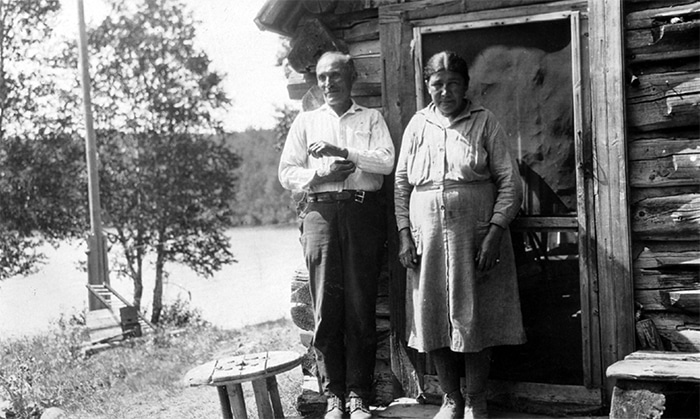


Some of the mats were made in the 1920s and 1930s by Helen Robinson Linklater, Tchi-ki-wis, an Ojibwe woman originally from the Lac La Croix area. Tchi-ki-wis and her husband operated a fishery on Isle Royale between 1927 and 1933, and Tchi-ki-wis often sold mats to tourists. The Linklaters are thought to be the last Native Americans to work and live on Isle Royale.
When the park was formed in the 1940s, island cabin-owner Frank Warren donated an extensive collection of indigenous items to the National Park Service, including the anaakanan. They will now be on an indefinite loan to Grand Portage.
“We wanted all the mats together in one place, especially if we find out that Linklater made them all,” Isle Royale National Park’s chief of Interpretation and Cultural Resources Liz Valencia told WTIP. “It could be the largest collection of hand woven mats by one person in the Great Lakes, or perhaps North America.”

The mats were welcomed to Grand Portage by park staff and band members after a 60-mile voyage aboard the park’s 22-foot boat Wolf from the park’s summer headquarters on Mott Island. Tribal council member John Morrin provided a culturally-appropriate reception. They will join another dozen mats in Grand Portage’s collection, including others by Tchi-ki-wis, four of them also from Isle Royale’s collection.
Experts say the artfully woven mats and their history exemplify the connection between Ojibwe people, who have lived along the North Shore for centuries, and the large island 20 miles off shore.
Last year, the indigenous significance of Isle Royale was recognized by the federal government as a Traditional Cultural Property, noting that people had been living on and visiting the site since long before European immigration.
“[The collection] documents historic connections, and continued modern connections to Isle Royale,” Valencia told WTIP. “This connection is still there today and it’s very strong.”

The mats recently loaned to Grand Portage were made primarily from the inner bark of northern white cedar trees, with one being made from sweetgrass. They were carefully prepared for their journey from Isle Royale to Grand Portage. Park staff consulted with National Park Service experts about the best methods for transport, rolling four of the mats that were flexible enough, and transporting one flat in a cardboard case.
Woven mats served both form and function. They were used on the floors of cabins or tents, as well as when working outdoors. But they also feature traditional designs with important significance.
“Designs were really important, intricate part of those mats,” Valencia said. “They weren’t just making mats to use on the floor, they were works of art.”
More information:
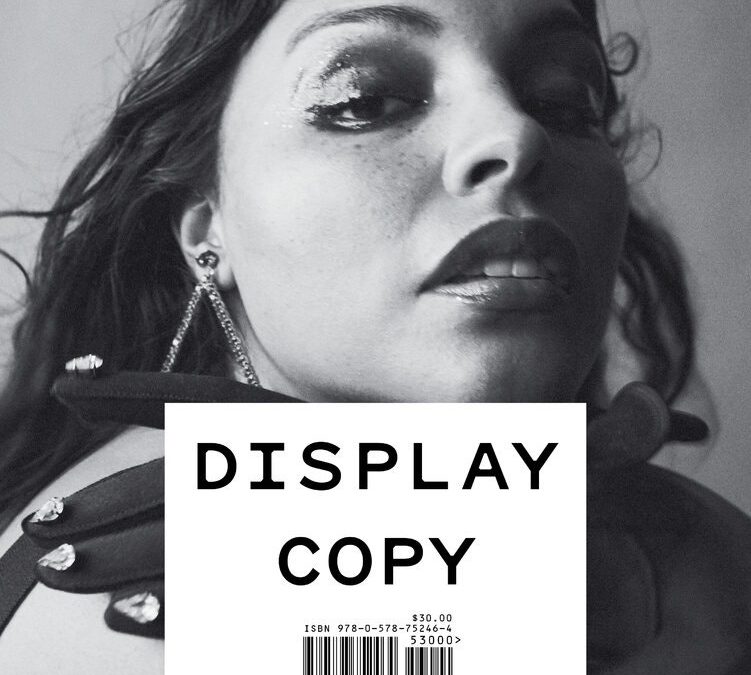
Disposability is no longer chic. A new magazine joins a host of big brands in exploring the joys of upcycling. Display Copy, the magazine that debuted online and on newsstands on Oct. 22, looks, in most ways, like a typical magazine.
It has a well-known model/personality on the cover: Paloma Elsesser, the plus-size model, inclusivity champion and British Vogue favorite. It has glossy shoots by famous photographers: Katerina Jebb and Mark Borthwick. And it has clothing credits that include Helmut Lang, Paul Smith, Adidas and Balenciaga.
In one way, however, it is not typical at all. The credits for “where to buy” include the Salvation Army, Etsy and eBay. Display Copy may be a new magazine, but, as the editor’s letter says, it “doesn’t feature a single new fashion item.” Every item of clothing it pictures and promotes is vintage. Secondhand. Thrifted. Pre-loved. For resale.
“The idea was to make used clothes desirable,” said Brynn Heminway, the editor of the magazine, which will have a constant stream of mostly shoppable online content, and will be published twice a year as a limited-edition collectible. “Because I honestly feel nothing new is sustainable. Everyone told me I would never get any advertising support, or anyone to write about it.” But it turned out, the timing was perfect.


After years of pushing only new, new, new (while behind the scenes scouring flea markets for inspiration), fashion brands are beginning, finally, to publicly embrace the old. Upcycling is reaching critical mass.
The week before Display Copy arrived, Miu Miu introduced Upcycled by Miu Miu: a limited collection of vintage dresses from the 1940s through the ’70s that have been tweaked, refashioned and otherwise jazzed up for a contemporary customer. The week before that, Levi’s unveiled Levi’s Secondhand, a buyback and resale program that will allow customers to sell their old denim to Levi’s so it can be repaired, reinvented and resold (or recycled).
They are both following in the footsteps of Maison Margiela, which put upcycling at the center of its creative process back in February when it introduced the Recicla line (Italian for “recycle”) — a collection built on garments the designer John Galliano’s team finds in charity shops and then deconstructs and reworks — and has since doubled down on the idea. Which itself came in the wake of Patagonia’s Worn Wear program, a pioneer in the field.

She is also plotting to reissue her most popular former styles, as is Michael Kors, who last season remade a cape from a fall 1999 collection and recently included a dress from spring 1991, originally worn by Anna Wintour to Grace Coddington’s 50th birthday party at Indochine, in his spring 2021 collection.
Add to that Cate Blanchett recycling her wardrobe during the Venice Film Festival in September.

“We’re just trying to put the spotlight on wonderful things that last,” Mr. Kors said in explaining his collection during a Zoom presentatio
That was, it turned out, a short-term way of thinking that reeked of insecurity, relying on freneticism and white noise. It may have boosted sales, but it also led to not only a glut of stuff but also an erosion of the value proposition. After all, if the company that made a garment didn’t think it was worth hanging on to for more than a few weeks, why should the person who buys it?
Once that confidence and understanding is lost, it is unclear how it ever comes back. Upcycling may be the answer.
“I started being a fashion designer because I never found anything I liked,” said Mrs. Prada, who hates throwing clothes away and has a whole separate apartment where she keeps her old wardrobe as well as her mother’s.
“Before that, for 10 years I dressed in vintage,” she continued. “I always asked myself why I liked it so much, and I think it’s the history. Each dress represents a person, a piece of a life. For me, the past always had an incredible value because anything you learn comes from there.”
Yet not that long ago, during a discussion in early 2019 for Muse magazine about fashion’s role in the climate crisis, I asked Marco Bizzarri, the chief executive of Gucci, why his brand didn’t take back its own clothes once consumers were done with them so they could be upcycled and resold. Why, though fashion was increasingly grappling with the environmental impact of materials at the start of a product’s life, there wasn’t as much focus on its end of life, or second life. At the time, he said it was too complicated and systems weren’t in place.

Credit…via Batsheva
–
So what changed? First, the fact that, early in the pandemic when countries were in lockdown, many mills were not working, so designers had to turn to deadstock (fabric left over from previous collections and a word that in itself reflects the industry’s former attitude) to create products.
This helped break the “old” barrier, said Batsheva Hay, who used her leftover fabric to make a series of limited-edition “housedresses.” Traditionally, she said, fashion had been “afraid of anything last season,” even though consumers have positive associations with the word “sustainability.”
Add to this the realization that consumers themselves were, as Giorgio Belloli, the chief commercial and sustainability officer of Farfetch, said, “changing their behavior and starting to see more value in their items.” (This in turn prompted Farfetch to expand its Second Life program, which allows customers to offer old handbags for on-site credit in Britain, the United States and several other countries in Europe.) They’re changing because of pandemic-induced economic factors and the understanding, no longer debated, that the responsibility to address the landfill problem lies not just with fashion producers, but also shoppers.
All of which has helped bolster the much heralded growth of the resale market, which ThredUp has predicted will hit $64 billion by 2024, with the online secondhand market growing 69 percent between 2019 and 2021. And the fact that increasingly, Gen Z, or what Ms. Heminway of Display Copy calls “the Depop generation,” has turned away from the waste of fast fashion and, priced out of even contemporary fashion, moved toward thrifting.

Credit…Daniel Jackson, via Display Copy
–
The result is a powerful combination of forces pushing fashion, and how we think about clothes, in a new direction. Though perhaps the most powerful force of all is self-interest — and not just commercial.
It turns out that the challenge of working with old stuff, of reinventing it, whether with technology or design (or both), has opened up whole new realms of intellectual and aesthetic possibility in the way that problem-solving often does. As Display Copy reads, “our intention is to celebrate the ingenuity we find in ourselves when we are determined to preserve the things we love.”
Mrs. Prada said working on Upcycled Miu Miu had been creatively inspiring. In a podcast about his Recicla initiative, Mr. Galliano called it “restorative.”
Who wouldn’t want to buy that right about now?
Vanessa Friedman is The Times’s fashion director and chief fashion critic. She was previously the fashion editor of the Financial Times. @VVFriedman

Halloween in the North Loop sponsored by the North Loop Neighborhood Association: With a warmer forecast for Saturday, it’s perfect to join your neighbors for a free outdoor movie & candy too at Target Field Station…bring a chair, blanket and a mask and enjoy!
When: Saturday, October 31 • Showtime is 6pm
Where: Target Field Station • 5th Ave North and 5th Street North, Minneapolis



Thinking ahead?
Let Revival make your Thanksgiving Holiday effortless! This year we will be offering a variety of Thanksgiving favorites for take and bake. You can view our take and bake menu and place an order by clicking order online at your desired location below. You’ll be able to pick-up your order on November 24th or 25th between 11 am and 9 pm. If you have any questions about our Thanksgiving offerings or would rather order over the phone please call us at our Nicollet Ave and Selby Ave locations. We look forward to being a part of your holiday!

525 SELBY AVE · SAINT PAUL, MINNESOTA 55102 · 651-340-2355
4257 NICOLLET AVE · MINNEAPOLIS, MINNESOTA 55409 · 612-345-4516
KEG AND CASE MARKET · 928 WEST SEVENTH STREET · SAINT PAUL, MINNESOTA 55102 · 651-321-2508