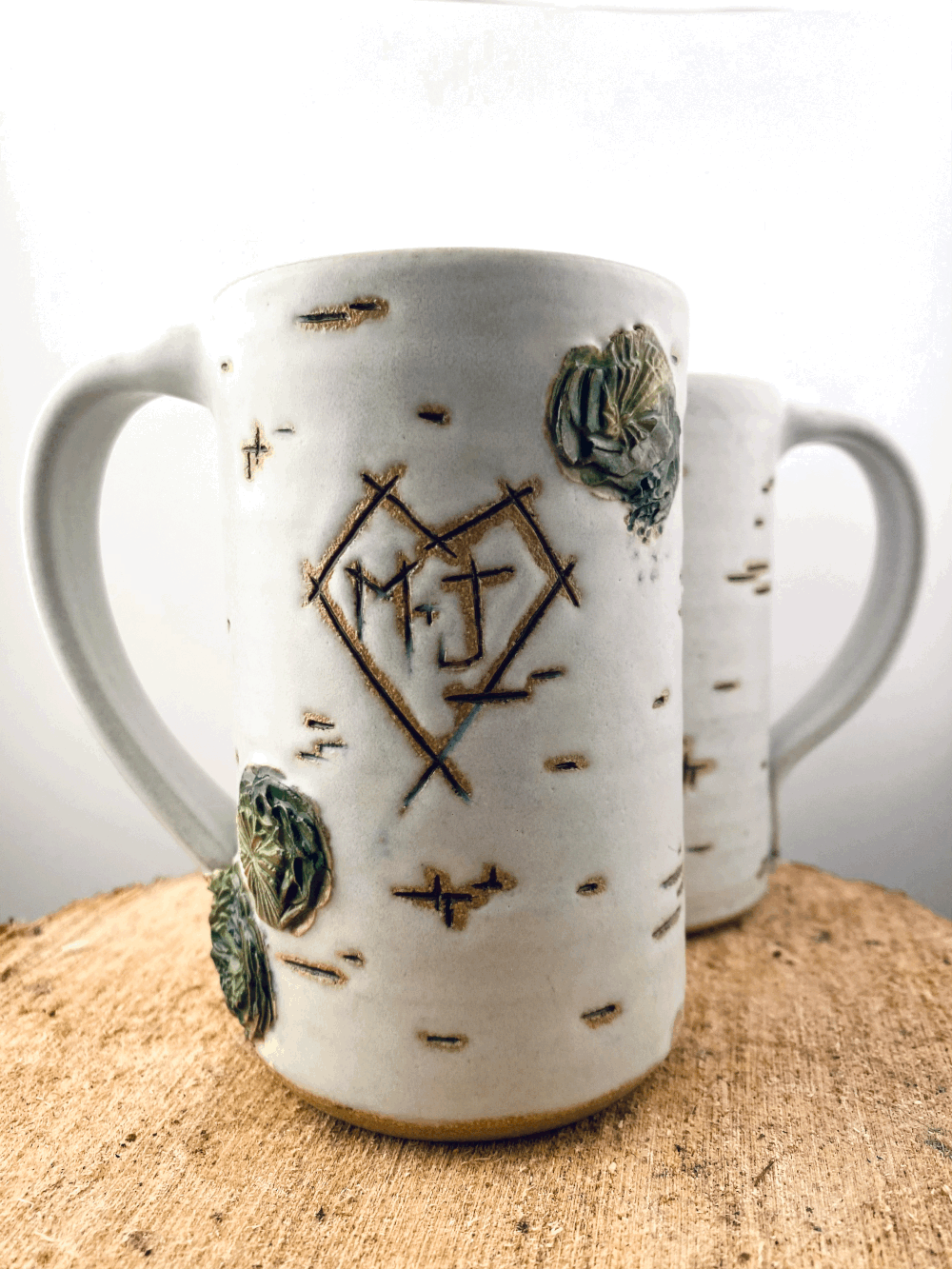
From artist Chelsey Wingness: Loves & lovers! It’s that time of year again for custom carved initials into birch mugs. You can order a set or individual mug – additional hearts for kids and furry children initials. Grandma & Grandpa? Mom & Dad? Be creative & I will do my best to make it work. Newly this year there is a lichen option available as well! Place orders now though January 31st on a fresh new website: Lakewoodceramics.com
Custom carved birch mug SET + lichen – 100.00
A+B/B+A Custom carved initials onto stoneware birch mug/lichen – 12oz CUSTOM MUGS TAKE AT LEAST FOUR WEEKS TO PROCESS & SHIP
The late John Tester’s book, “Minnesota’s Natural Heritage,” will be launched as an updated second edition in January 2021. The second edition of “Minnesota’s Natural Heritage” introduces readers to the major ecosystems that give our state its rich and varied character and have been profoundly altered in the twenty-five years since the book’s first edition. In an interview with the Star Tribune, the authors talk about their connections to Tester and why the new edition of “Minnesota’s Natural Heritage” is due. Visit the link to read more and join us on January 21 for a virtual book launch with a conversation exploring this definitive work on Minnesota’s natural history and ecology!
–
The story of Minnesota’s natural landscape, reaching back to the time of the glaciers, covers at least 12,000 years. Yet even against that vast expanse, recent decades have significantly transformed the natural world that is Minnesota’s greatest resource. In the second edition of Minnesota’s Natural Heritage, readers are introduced to these ecosystems—the lakes and rivers, forests and prairies, farmlands and wetlands—and how they have come to be, how they function, and how they have changed so rapidly and dramatically in recent years. Full-color illustrations document the state’s striking natural beauty in all its vigor and fragility, while maps, drawings, diagrams, and graphs amplify points of historical, ecological, and geological interest.
The new Bell Museum brings together science, art, and the environment with a unique Minnesota perspective. Our new home features a digital planetarium, high-tech exhibits, our famous wildlife dioramas, outdoor learning experiences and more.
The new facility is expected to triple the number of annual visitors—and we hope you’re one of them. If you love to explore and discover, you’ll love the Bell Museum more than ever before!
Our state-of-the-art planetarium takes you on amazing journeys from the far reaches of the cosmos to deep inside the human brain. Learn more about our dome and other space programs.
The permanent galleries—which include our world renowned wildlife dioramas—span space and time, from the origins of the universe, through the diversification of life on Earth, to Minnesota’s own unique habitats. Also, learn about U of M researchers who are working to create a better future for our evolving world.
The Bell Museum created the first natural history museum discovery room in the world, and we are proud to carry that tradition on in the new Touch & See Lab where all ages can actively learn through observation and sensory engagement.
The learning continues outside with a second floor green roof and observation deck, and sustainable landscaping with native plants, geology exploration area, solar station, and other highlights on the ground floor.
As the state’s natural history museum, the Bell Museum seeks to ignite curiosity and wonder, explore our connections to nature and the universe, and create a better future for our evolving world. Our goal is to advance understandings of the natural world that will create a sustainable future.
These understandings include the traditional knowledge systems of indigenous peoples, the first inhabitants and caretakers of the land. These systems capture histories, relationships, and ecological expertise. To advance our mission, we rely on and share some aspects of indigenous knowledge systems and understandings of the land. We do this in consultation with indigenous peoples.
The Bell Museum sits on the traditional and treaty land of the Dakota people who, along with the Ojibwe people, are the indigenous peoples of the land now called Minnesota. In recognition of this fact, and to honor the Dakota people for their care of and knowledge of this land, we waive general museum admission for Dakota and all indigenous peoples.
How Ugg learned to play the high-fashion game. It started with Rihanna, as these things so often do.
It was the halcyon days of 2018 and the pop singer and fashion icon wore a pair of Uggs to — where else? — the Coachella music festival.
Not your average pair, like the classic boots made famous by a Juicy Couture-clad Lindsay Lohan at the height of her Us Weekly fame in the early aughts. This pair was a collaboration with the Belgian designer Glenn Martens of the avant-garde label Y/Project, who exploded the ostentatiously unsexy style to Brobdingnagian proportions, yielding a version that was high-heeled, slouchy and reached well above mid-thigh. A picture of Rihanna in the wader-like footwear amassed more than 3.3 million likes on Instagram, and even Vogue couldn’t resist their strange allure.
“The C.F.O. was not super-excited about them,” Andrea O’Donnell, the Ugg brand president, recalled. After seeing a CNN news segment of the Y/Project runway show in which they were unveiled, “he came in and said, ‘Tell me that I didn’t see thigh-high boots, on a catwalk, worn by a man,’” she said, laughing.
Ms. O’Donnell had been hired in 2016 to help reposition the brand with consumers who associated Ugg with the classic boot in its purest form: shin-high, slip-on, mocha brown and lined in sheepskin. It was a casual style, to be worn with yoga pants while running errands. Ugg wanted to widen its image to encompass more fashion-forward associations.
And Ugg had lost its luster. Once the boot du jour for carefree socialites and off-duty starlets, it had become part of the uniform of a certain upwardly mobile consumer with bland bourgeoisie taste. The label was hardly the first to experience this trajectory. It’s a common one in fashion: Things that once had an air of exclusivity and mystique are then fully absorbed by the culture. Uggs were beloved but mass market.
Ms. O’Donnell, who came from the luxury department store Lane Crawford, moved to Santa Barbara, Calif., where Deckers, the Ugg parent company, is based, and got down to work, initiating a series of high-profile collaborations to inject some glamour into the label.
“We needed to engage the fashion community about what our brand could be,” Ms. O’Donnell said.
She has since assembled a roster of collaborations that are as eclectic as they are eccentric. Far from tapping, say, luxury labels in the European mold (recent partnerships between Prada and Adidas or Dior and Nike Air Jordan come to mind), Ugg chose designers with edgier, artier inclinations, which helped reinforce what Ms. O’Donnell said is the brand’s potential to be both aspirational and accessible.
“Ugg really needed to reinvent itself,” said Ayako Homma, an analyst at the market research firm Euromonitor International, citing market saturation and counterfeits as reasons for waning consumer interest. “And collaborations are a great way to revamp the brand image by bringing in new styles and new consumers — especially teens and younger adults, many of whom may not be familiar with the brand or haven’t owned a pair before.”
Ugg kicked things off with the Los Angeles enfant terrible Jeremy Scott, who plastered his boots with a kitschy flame print, and it followed up with the New York designer Phillip Lim, whose designs featured front zippers, pops of orange and rubber guards that recalled duck boots.
Last year, the arty bicoastal duo behind Eckhaus Latta made clunky square-toed clogs and mules, and the louche streetwear label Stampd created a convertible pair that could transform from slippers to boots, which the website Highsnobiety called “peak work from home footwear.”
Next up are the British designer Molly Goddard, she of the tulle extravaganzas, who showed platform mules, shaggy slippers and boots with floral appliqués at her spring 2021 show, and the Brooklyn designer Telfar Clemens, whose patchwork, logo-strewn boots (plus bedazzled T-shirts, oversize hoodies and fur-lined bucket hats) will be released next year.
“They are basically an accessible luxury,” said Mr. Clemens, who has upended old ideas about gender and identity. “It’s a Christmas list thing for hundreds of thousands of people. That’s the sort of space we want to occupy.”
Department stores known for their discerning product mix, like Nordstrom and the Canadian retailer SSENSE, have taken notice and started to carry the limited-edition releases.
“The totally unexpected nature of the collaborations continues to keep the brand relevant,” said Brian Costello, the vice president and merchandise manager for women’s shoes at Nordstrom. And while the limited editions generate excitement within targeted communities, they do so without alienating fans of the core collection.
Telfar Clemens collaborated with Ugg on a collection that will be released next year. Credit…via Ugg
–
Ms. O’Donnell, whose first memory of the brand is Pamela Anderson wearing Uggs with her red “Baywatch” swimsuit (Ms. Anderson, an animal-rights activist, has since renounced the boots), calls the classic boot a “cultural icon.” That sort of talk is often ballyhoo, but in this she’s not wrong. Uggs permeated the zeitgeist in a way few other footwear brands can claim.
–
Oprah Winfrey included them in her annual “Favorite Things” episodes, starting in 2003, creating a frenzy. Celebrities often wore them between takes while filming, which continued to raise their profile. And starlets helped forge an image of them as glamorous and casual in the early part of the century. Originally they were worn by surfers to keep their feet warm after a morning of wave-riding, giving them instant street (beach?) cred. Still, without constant tending and innovation, a brand built around one signature item can easily get stuck in a rut.
–
“Uggs will always and forever remind me of coming of age in the early aughts, seeing them on celebrities like Jessica Simpson on ‘Newlyweds’ or Paris Hilton shopping at Kitson,” said Tyler McCall, the editor in chief of the Fashionista website. “Lately, though, they also bring up images of a very specific, cool-art-scene kid.”
Fluff Yeah slides. Credit…via Ugg
For Ms. McCall, it was those Y/Project boots that helped her see the boots anew. “At first it was like, ‘Wait, these are crazy!” then, ‘Are these crazy, though?’ and finally, ‘Wait, maybe these are so crazy they’re cool?’”
“With the internet, it feels like there is a dizzying number and array of fashion circles, and Ugg has made its way into a few of them,” Ms. McCall said. “Whether it’s people interested in these buzzy collaborations or those who want to wear them with a sort of nod-wink ironic nudge to that millennial aesthetic.”
While the collaborations have been able to whip up excitement in the fashion community, serendipitous outside forces have added to Ugg’s recent good fortune. It is one of few fashion brands poised to benefit from the novel coronavirus as stay-at-home orders and mandated quarantines created a surge in popularity for cozy apparel and accessories, like sweats and house slippers. Uggs may be just the regression we all need in these times.
Additionally, nostalgia for trends from the early aughts has experienced a renaissance in recent years, fueling a fervor for Puma sneakers, Prada nylon bags and other brands of the era. And while Uggs have been derided by some as downright unattractive, ugly shoes are popular in certain cool-kid circles. Ms. Homma of Euromonitor likened Ugg’s trajectory to the ascent of another ugly-covetable shoe: Crocs.
In its most recent quarterly earnings call, in late October, Ugg reported a modest increase in net sales, at 2.5 percent. Ms. Homma noted that, considering the challenging retail environment of the last year, that figure actually reads as quite resilient.
Ugg Classic Mini ambassadors, from left, Joan Smalls, Irina Shayk, Emily Ratajkowski and Jasmine Tookes.Credit…via Ugg; Jared Siskin/GC Images; Dia Dipasupil/GC Images; John Sciulli
–
In September, Lyst, the fashion search platform, noted: “As ugly boots are replacing ugly sandals post-summer, demand for Ugg boots is growing 24 percent week on week. Over the past month, there have been more than 41,000 searches for the brand.”
Moreover, the availability of these particular partnerships is concentrated, with the ultimate goal of creating a halo effect around other products, like the Fluff collection, which has been seen on Serena Williams, Cardi B and Justin Bieber (who, in 2010, told Seventeen magazine he thought Uggs were “ugly”).
To further expand its image, the company recently released a campaign starring the pierced and tattooed Dennis Rodman and the pink-haired skater du jour Evan Mock mugging on a debris-filled mansion lawn. And last month a new flagship store concept, which leans heavily into sensual curves and terrazzo floors, was unveiled on Fifth Avenue.
So, like it or not, Uggs are cool again. Or maybe they were always cool. Or, keeping in mind the strange and fickle ways that trends ebb and flow in the social media era, maybe they were never cool, which is what makes them, well, cool.
Whether you want to practice your Flying V or polish your toe pick, Minnesota’s outdoor ice skating rinks are the perfect surface for winter fun.
Found in every corner of the state, ice rinks form on frozen lakes, ponds and even rivers as soon as the ice is thick enough, with refrigerated rinks popping up around Thanksgiving or even earlier. In addition to skating, most of the rinks on this list have skates available for rent, as well as warming houses and/or other perks like concessions and special events. So channel your inner Neal Broten or Kristy Yamaguchi and head out to these ice rinks across the state.
The Roseville Oval lit up for the holidays
–
Outdoor Ice Skating Rinks in the Minneapolis-St. Paul Area
When it comes to ice skating, few places do it better than the Twin Cities. Both St. Paul and Minneapolis host free ice rinks beneath their shimmering downtown skylines (Wells Fargo WinterSkate and WinterSkate in Loring Park, respectively, are both on hiatus this year), and countless neighboring cities have their own impressive rinks.
You can skate North America’s largest outdoor refrigerated rink in Roseville, or head to Maple Grove to carve your way across one of the country’s only refrigerated ice skating trails. If frozen lakes are more your style, head to Edina, Buffalo, or one of three lakes in Minneapolis (Lake of the Isles, Nokomis and Powderhorn).
Lake Alice in Fergus Falls opens for skating with a big party on the ice
–
Outdoor Ice Skating Rinks in Central Minnesota
In Fergus Falls, Lake Alice is plowed for both a skating rink and a track around the lake, and remains open for as long as conditions allow. In St. Cloud, Lake George is the place to skate, or head to Blackberry Ridge Golf Club in nearby Sartell, where you can warm up before or after your skate at the club’s Grill 19. Other places to skate in this region include Alexandria, Pine River, Hutchinson, New York Mills and the Brainerd Lakes area, which features rinks on Gull Lake for guests staying at Cragun’s Resort or Grand View Lodge.
Rent skates or BYO to Lake Winona in southeast Minnesota / Visit Winona
–
Outdoor Ice Skating Rinks in Southern Minnesota
The towering bluffs of southeast Minnesota make a beautiful backdrop for skating in Winona, a year-round destination for outdoor recreation. But lakes aren’t the only bodies of water that freeze in the winter. The Straight River, a 55-mile tributary of the Mississippi, has hockey and skating near downtown Owatonna, or you can skate on an inlet of the Des Moines River in southwest Jackson.
Several outdoor skating rinks can be found in Albert Lea, Mankato and Rochester, where you can skate on a frozen running track.
Kids and adults play pond hockey at Ashley Park in Jackson / Singvongsa Photography
–
Outdoor Ice Skating Rinks in Northeast Minnesota
You can’t skate on Lake Superior, but you can get pretty close at Bayfront Festival Park in Duluth. After the Bentleyville Festival of Lights wraps up, the park transforms into an ice skating rink in early January. Further up the North Shore, outdoor rinks can be found in Knife River, Two Harbors, Silver Bay, Tofte and Grand Marais.
Further south in the hockey-loving Iron Range, there are rinks in Biwabik (minutes from the Giants Ridge ski resort), Hibbing and Virginia. While on the Range, pay a visit to the U.S. Hockey Hall of Fame in Eveleth. Or head to Grand Rapids for your choice of four outdoor rinks, including a covered one at the IRA Civic Center.
Visit the Paul Bunyan and Babe the Blue Ox statues just outside of downtown Bemidji / Weston Holland
–
Outdoor Ice Skating Rinks in Northwest Minnesota
Bemidji is no stranger to fun on the ice. In addition to the city’s four indoor ice arenas, there are two outdoor skating destinations. Warroad, whose nickname is “Hockeytown USA,” has a free outdoor rink behind its two indoor ice arenas. Duck inside both buildings for a look at the town’s impressive hockey history. Further south, Detroit Lakes’ Peoples Park is another skating destination in this region.
Erica Wacker is a Midwesterner through and through, growing up in Illinois, going to college in Wisconsin, and settling down in Minnesota. She loves to run, travel with her family, and go to concerts to relive her youth.
…and became America’s first climate-controlled indoor shopping mall!
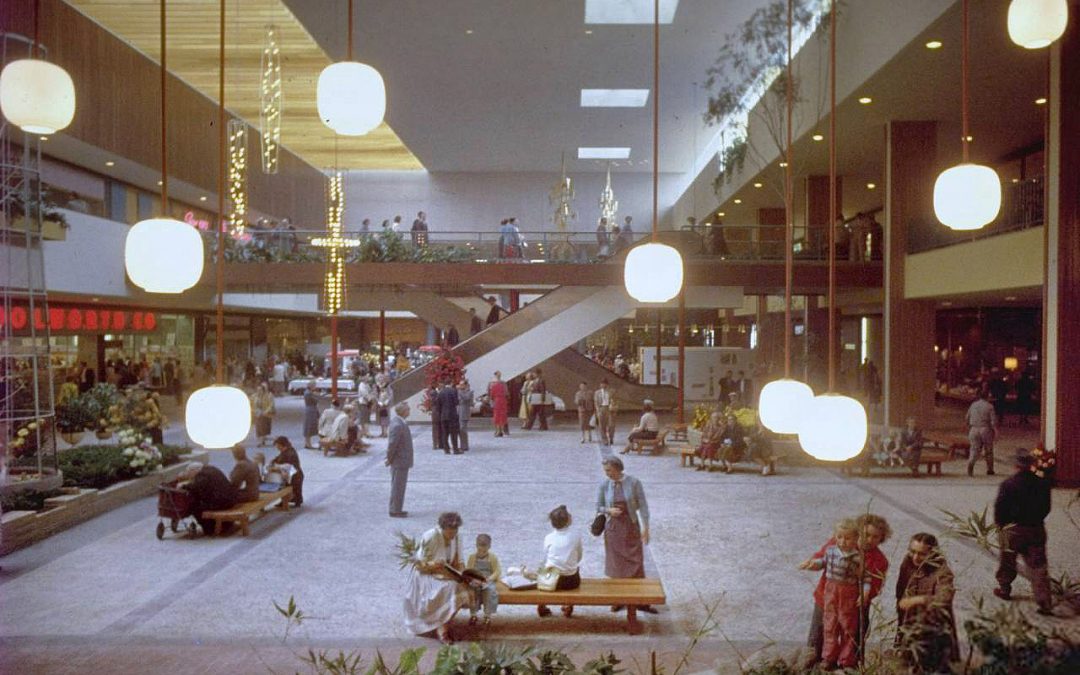
The mall’s architect, Victor Gruen, designed the building to mimic Vienna’s outdoor squares, with plants hanging from the balconies and plenty of space for people to mingle. In the atrium, there was a fish pond, large faux trees, and a 21-foot cage filled with birds.
If you take a look at the video above, shared by Kottke.org, you’ll notice that Southdale Center looks a lot like a typical mall. Designed by Victor Gruen, the father of suburban American shopping malls, the layout was revolutionary at the time but has since been copied by shopping centers across America. (For more on Gruen, listen to this great episode of the podcast99 Percent Invisible.)
The mall’s highlight was the central atrium, topped by a skylight, which Gruen designed as a kind of indoor town square. The exteriors were designed to be boring in order to make the dazzling interiors seem more exciting by contrast, encouraging people to stick around and shop rather than exit.
However, by the end of his life, Gruen had become an outspoken critic of shopping malls, which he had envisioned as a solution to suburbia’s lack of walkable public space. While Southdale is still open, America’s indoor shopping malls are largely dying, often finding new life as things like medical centers or residential developments.
Image: The Southdale Center in Edina, Minnesota in 1956. Life magazine photo archive