by doitinnorth | Jun 26, 2020 | style/mode
…will we see this type of basin become increasingly more popular?
Hairbrained exists as a community for
artists, craftspeople and educators to come together to
create, inspire and share. Founded in 2009, Hairbrained.me began as an online home for truly
passionate professionals. Over time, the Hb community has grown into an online home for 6
0,000+ registered members. Our social/mobile following has grown to
over 1,100,000+ #crafthairdressers and is expanding every day.
by doitinnorth | Jun 19, 2020 | style/mode
Illustrations by Eleni Kalorkoti
By Tara Parker-Pope
Of the many things we miss from our pre-pandemic lives, hugging may top the list. We asked scientists who study airborne viruses to teach us the safest way to hug.
A Canadian woman was so desperate to hug her mother during quarantine that she created a “hug glove” using a clear tarp with sleeves so the women could hug through the plastic. A video of two young cousins in Kentucky hugging and weeping after weeks apart in quarantine was shared thousands of times.
“We did not expect for them to react the way they did,” said Amber Collins, who recorded the reunion of her 8-year-old son, Huckston, with his cousin Rosalind Arnett, age 10. “They were so overjoyed they didn’t know how to express themselves, except to cry. This hug shows how powerful the human touch truly is.”
Not only do we miss hugs, we need them. Physical affection reduces stress by calming our sympathetic nervous system, which during times of worry releases damaging stress hormones into our bodies. In one series of studies, just holding hands with a loved one reduced the distress of an electric shock.
“Humans have brain pathways that are specifically dedicated to detecting affectionate touch,” says Johannes Eichstaedt, a computational social scientist and psychology professor at Stanford University. “Affectionate touch is how our biological systems communicate to one another that we are safe, that we are loved, and that we are not alone.”
To learn the safest way to hug during a viral outbreak, I asked Linsey Marr, an aerosol scientist at Virginia Tech and one of the world’s leading experts on airborne disease transmission, about the risk of viral exposure during a hug. Based on mathematical models from a Hong Kong study that shows how respiratory viruses travel during close contact, Dr. Marr calculated that the risk of exposure during a brief hug can be surprisingly low — even if you hugged a person who didn’t know they were infected and happened to cough.
Here’s why. We don’t know the exact dose required for the new coronavirus to make you sick, but estimates range from 200 to 1,000 copies of the virus. An average cough might carry anywhere from 5,000 to 10,000 viruses, but most of the splatter lands on the ground or nearby surfaces. When people are in close contact, typically only about 2 percent of the liquid in the cough — or about 100 to 200 viruses — would be inhaled by or splashed on a person nearby. But only 1 percent of those stray particles — just one or two viruses — actually will be infectious.
“We don’t know how many infectious viruses it takes to make you sick — probably more than one,” said Dr. Marr. “If you don’t talk or cough while hugging, the risk should be very low.”
There’s tremendous variability in how much virus a person sheds, so the safest thing is to avoid hugs. But if you need a hug, take precautions. Wear a mask. Hug outdoors. Try to avoid touching the other person’s body or clothes with your face and your mask. Don’t hug someone who is coughing or has other symptoms.
And remember that some hugs are riskier than others. Point your faces in opposite directions — the position of your face matters most. Don’t talk or cough while you’re hugging. And do it quickly. Approach each other and briefly embrace. When you are done, don’t linger. Back away quickly so you don’t breathe into each other’s faces. Wash your hands afterward.
And try not to cry. Tears and runny noses increase risk for coming into contact with more fluids that contain the virus.
While some of the precautions may sound like a lot of effort for a simple hug, people need options given that the pandemic will be with us for a while, said Julia Marcus, an infectious disease epidemiologist and assistant professor at Harvard Medical School.
“There’s a real challenge right now for older people who worry that they won’t be able to touch or connect with family for the rest of their lives,” said Dr. Marcus. “Keeping hugs brief is particularly important because the risk of transmission increases with more prolonged contact.”
Here are the Dos and Don’ts of hugging, based on the advice of Dr. Marr and other experts.
❌
DON’T hug face-to-face
“This position is higher risk because the faces are so close together,” said Dr. Marr. “When the shorter person looks up, their exhaled breath, because of its warmth and buoyancy, travels up into the taller person’s breathing zone. If the taller person is looking down, there is opportunity for the huggers’ exhaled and inhaled breaths to mingle.”
❌
DON’T hug cheeks together, facing the same direction
This position, with both huggers looking in the same direction, also is higher risk because each person’s exhaled breath is in the other person’s breathing zone.
✔️
DO hug facing opposite directions
For a safe, full-body hug, turn your faces in opposite directions, which prevents you from directly breathing each other’s exhaled particles. Wear a mask.
✔️
DO let children hug you around the knees or waist
Hugging at knee or waist level lowers risk for direct exposure to droplets and aerosols because faces are far apart. There is potential for the child’s face and mask to contaminate the adult’s clothing. So you might consider changing clothes, and wash your hands after a visit that includes hugs. The adult also should look away so as not to breathe down on the child.
✔️
DO kiss your grandchild on the back of the head
In this scenario, the grandparent is minimally exposed to the child’s exhaled breath. The child could be exposed to the taller person’s breath, so kiss through a mask.
Julian Tang, a virologist and associate professor at the University of Leicester in England who studies how respiratory viruses travel through the air, said he would add one more precaution to a pandemic hug: Hold your breath.
“Most hugs last less than 10 seconds, so people should be able to manage this,” Dr. Tang said. “Then back away to at least two meter separation before talking again to allow them to catch their breath at a safe distance. Holding your breath stops you exhaling any virus into their breathing zone, if you are unknowingly infected — and stops you inhaling any virus from them, if they are unknowingly infected.”
Yuguo Li, a University of Hong Kong engineering professor and senior author on the paper that Dr. Marr cited to make the calculations, said that hugs probably pose less risk than a longer face-to-face conversation. “The exposure time is short, unlike conversation, which can be as long as we like,” he said. “But no cheek kissing.”
Dr. Li said the risk of viral exposure may be highest at the start of the hug, when two people approach each other and could breathe on each other, and at the end, when they pull apart. Wearing a mask is important, as is hand washing, because there’s a low risk of picking up the virus from another person’s hands, skin or clothes.
Dr. Marr noted that because the risk of a quick hug with precautions is very low but not zero, people should choose their hugs wisely.
“I would hug close friends, but I would skip more casual hugs,” Dr. Marr said. “I would take the Marie Kondo approach — the hug has to spark joy.”
By Tara Parker-Pope
Tara Parker-Pope is the founding editor of Well, The Times’s award-winning consumer health site. She won an Emmy in 2013 for the video series “Life, Interrupted” and is the author of “For Better: The Science of a Good Marriage.” @taraparkerpope
Illustrations by Eleni Kalorkoti
by doitinnorth | Jun 19, 2020 | art/design
AN AUTHENTIC EXPERIENCE
In a world full of manufactured experiences, we have very few opportunities to fully immerse ourselves in authenticity. Glensheen offers one of those rare chances. Come see why Glensheen Mansion, perched on the shore of Lake Superior, is the most visited historic home in Minnesota. Our 12-acre estate features gardens, bridges, and the famous 39-room mansion built with remarkable 20th century craftsmanship, telling the story of the Duluth region.
A FAMILY AFFAIR
Chester and Clara Congdon built Glensheen between 1905 and 1908 as their home. This influential family is known for opening up iron mining in this region and setting aside land for public use, such as the North Shore Scenic Highway and Congdon Park. Glensheen was donated to the University of Minnesota and opened as a historic house museum in 1979 and, here’s the amazing part: the collection is intact. The top hat in the closet? That was Chester Congdon’s. The letters in the desk drawer? Those were written by Clara. The sheets in the linen closet? Organized by the Congdons’ 2nd-floor maid nearly 100 years ago. And that’s just inside the mansion… Keep scrolling to find out more!
A PLACE TO CALL HOME
“I will have quiet neighbours,” Clara Congdon wrote in her diary, referring to the cemetery to the west of Glensheen. Nestled between Tischer Creek, Bent Brook, and Lake Superior, Chester and Clara Congdon envisioned a home that would serve as a calming refuge for their family for generations to come. 3300 London Road, Glensheen’s address, was considered far-removed in 1905, the year construction began. By 1908, after three years and nine months, Glensheen was completed by transforming the heavily wooded area into an efficient yet magnificent estate. By all accounts this conversion was not an easy task. The Congdons, the architect Clarence H. Johnston, the landscape architect Charles W. Leavitt, and the interior designer William A. French collaborated on the project. Glensheen is a testament to the skills and craftsmanship available more than 100 years ago.
NATURAL BEAUTY
The Congdon estate originally included 22 acres of lakeshore property. At the time, the area was heavily wooded and the shoreline was rugged, yet the Congdons saw the potential for a gracious, formal estate and practical home for a busy family with six children. Charles Wellford Leavitt, Jr. was a civil and landscape engineer with offices in New York City. As the landscape architect of Glensheen, Charles was directed by the Congdons to preserve as much of the natural beauty of the property as possible. He was also charged with making the estate self-sufficient, which required plans for a large vegetable garden, a greenhouse, an orchard, a cow barn and a water reservoir.
Relax by the Lake with us. Walk to the end of the Pier. Stack rocks near the shore. Skip rocks into the Lake. Listen to the rolling waves. All are perks of a Grounds Pass when visiting Glensheen. The grounds are now open 9:00 am – 5:00 pm daily.

Grounds passes are $5 for adult non-members and free for those 15 years old & under with a paid adult Grounds Pass. Members, UMD students, and Active Military Personnel also receive FREE grounds passes. Learn more at
glensheen.org.
by doitinnorth | Jun 19, 2020 | people/passions
Where the Trail Ends Your Voyage Begins… For all of your Boundary Waters Canoe Area and Quetico Park outfitting needs choose Voyageur Canoe Outfitters. Located on the edge of the BWCA with direct access to Saganaga from our dock on the Seagull River…
…Voyageur Canoe Outfitters is conveniently located on the edge of the most beautiful, lake based and paddle only wilderness in the world. Our location on Saganaga Lake and the Seagull River (BWCAW entry point #55), allows for a relaxed atmosphere prior to your BWCA Wilderness canoe trip adventure. Upon arriving at this magnificent lakefront setting, a feeling of tranquility and peace will begin to develop within you. The beauty of the BWCA Wilderness natural wilderness and its exceptionally fresh air will cause you to breathe a deep sigh of relief, as the cares of your daily world begins to melt away.
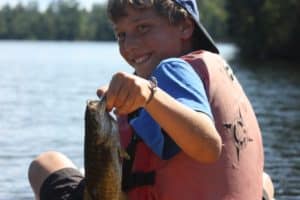
The Voyageur Crew is here to introduce our guests to the special joy of wilderness paddling. Relaxing at a campsite, enjoying the abundant wildlife, and paddling the crystal clear lakes of the BWCAW (while hopefully catching a fish or two) are just a few of our favorite things to do in this life of ours at the end of the Gunflint Trail. Once you paddle through Voyageur we believe you will never want to outfit anywhere else. We are confident that you will completely enjoy your time with us and we guarantee your satisfaction. Think about it, life is too short and vacations are even shorter. It makes the best sense to go with a sure thing.
Your vacation is our livelihood. Voyageur Canoe Outfitters was born from the sheer love of sharing wilderness adventures with people like you. Our lives are devoted to creating the very finest experiences in the industry, which we have perfected since 1961. The BWCA Wilderness is our playground and we are dying to share it with you. Canoeing is streamlined to maximize your bird and wildlife sightings and the experience will only help you relish this natural world even more. The Voyageur Crew is made up of charismatic adventurers who are knowledgeable, committed to your safety, and devoted to giving you memories you will treasure for life. Best of all, our respect for the wild moose, fish, eagles and loons extends to our camping and cabin practices. We operate under the strictest, ‘Leave-No-Trace’ ethics. Even our Base Camp package remains eco-friendly without permanent structures or fueled devices, so you can enjoy the wildlife without harming their habitat. Rest assured that on a VCO trip, you would leave this special world as pristine as you found it.
The Spirit of the Voyageur is something we at Voyageur believe strongly in. The kind of adventure where you become in tune with nature and every moment is breathtaking. Listening to the call of the wild, laughing around an evening campfire, or paddling past a majestic moose are just some of the wonderful things you can experience here in the beautiful and vast BWCAW or Quetico Park. Let the spirit of the Voyageur call you to where the Gunflint Trail ends and your Voyage begins.
VOYAGEUR CANOE OUTFITTERS
by doitinnorth | Jun 19, 2020 | events/locations
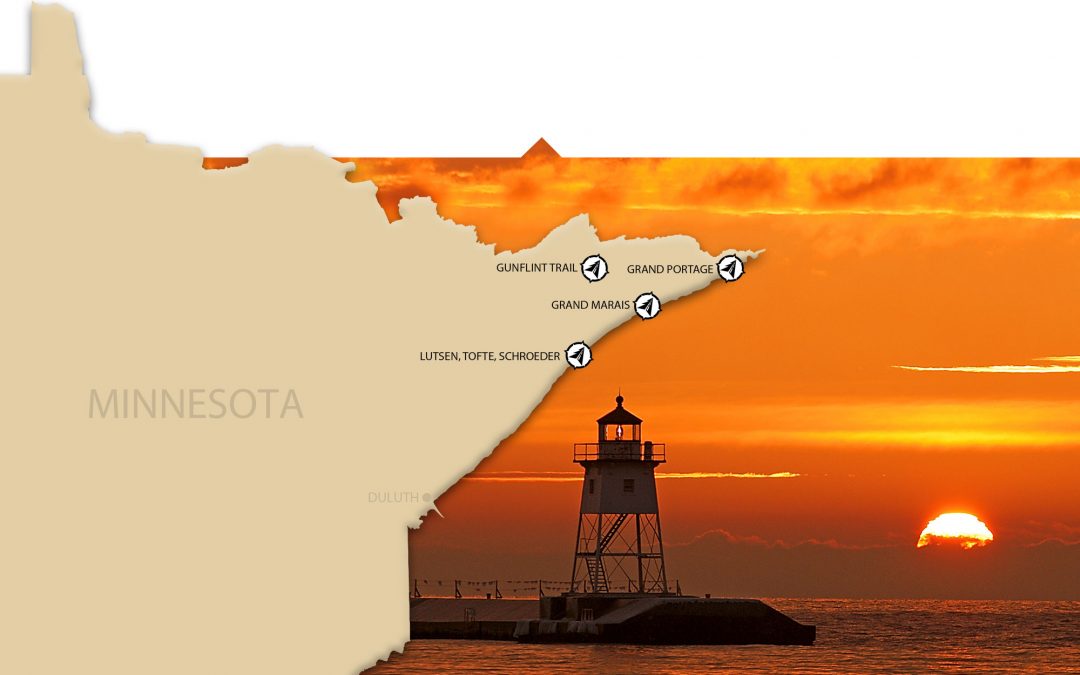
Cook County is located at the northeastern tip of Minnesota’s Arrowhead, with Lake Superior’s north shore on one side and the Sawtooth Mountains and Boundary Waters Canoe Area Wilderness (BWCAW) on the other. The nearest large city is Duluth, Minnesota. We may be in northern Minnesota, but we’re easy to find and get to. Cook County, Minnesota is only four-and-a-half hours north of the Twin Cities. We’re also easy to reach from the Iron Range, Chicago, Thunder Bay, Madison and other areas in the Upper Midwest and beyond.
____
Strung along the Lake Superior shore like beads on a necklace, the communities of Lutsen, Tofte and Schroeder serve as the southern gateway to Cook County, Minnesota. This region is the perfect vacation destination, whether you’re looking for romance, adventure, relaxation or family fun. It all happens here, where the great Lake Superior meets the ancient Sawtooth Mountain Range. There’s always something new to explore.
___
Artsy and quirky, the North Shore harbor village of Grand Marais welcomes creatives, families and adventure-seekers alike. The accolades almost speak for themselves. Grand Marais has been named America’s Coolest Small Town (Budget Travel Magazine), Top 10 Beach Getaways (Outside Magazine), and Next Great Adventure Town (National Geographic Adventure Magazine). In Grand Marais you’ll meet some of the most friendly, creative and talented people – both visitors and locals alike.
___
Shhh, is that a moose? Uncover the history and allure of this 57-mile National Scenic Byway at the edge of the Boundary Waters Canoe Area Wilderness (BWCAW) and Canada’s Quetico National Park. We all romanticize about a quaint, little lodge in the woods. But on the Gunflint Trail, it’s real. The log lodge, the grand resort, the shimmering lakes and a million acres of pristine Minnesota forest. It doesn’t get much better than this.
___
At the very tip of Minnesota’s Arrowhead, about 45 minutes northeast of Grand Marais, sits the community of Grand Portage. Grand Portage is a place of enduring tradition and vibrant culture. Home to the Grand Portage Band of Lake Superior Chippewa, this community is one of the earliest Ojibwe settlements in Minnesota. Grand Portage has been a legendary meeting place for centuries – and after one visit you’ll understand why.
VISIT COOK COUNTY MN