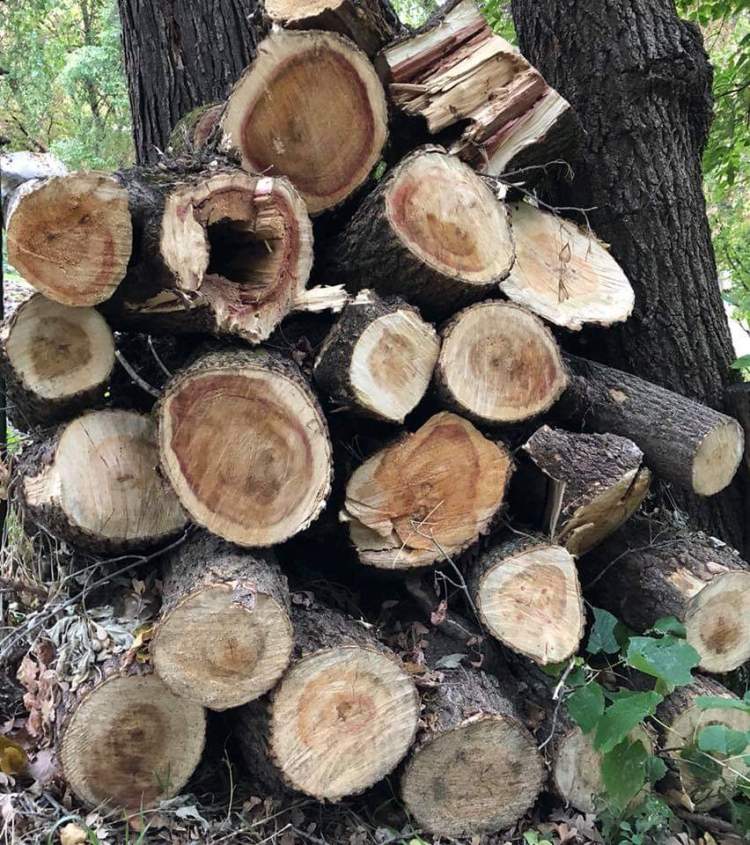


A few random wood piles seen out and about in Otter Tail County.





Thank you for the many ways you continue to reach out, volunteer, donate and support the Foodshelf as we respond to the COVID-19 pandemic. This time has challenged all of us in unprecedented ways. To those in our community who are concerned about food scarcity, we are here for you! We are working with our food banks, community partners, other service providers and Hunger Solutions to ensure we are able to continue to be a food resource in our community.
On March 25, Governor Tim Walz issued an executive order for Minnesotans to “stay at home” to prevent further spread of the virus. Under its provisions, food banks and food shelves are classified as critical sector work. At this time, Joyce Uptown Foodshelf remains open, but our model and service hours have changed and will continue to evolve as needed to prioritize the health and safety of the communities we serve and the staff and volunteers who support them. Our goal is to remain a resource to our community during this crisis. Please check our webpage at joyceuptownfoodshelf.org regularly for updates. The safety and well-being of our participants, staff, and volunteers is our top priority as we work hard to continue to provide food support to our community. If you are in need of other food resources, please call the MN Food Help Line at 1-888-711-1151.

Hunger Solutions Minnesota works to end hunger in our state. We take action to assure food security for all Minnesotans by supporting programs and agencies that provide food to those in need, advancing sound public policy, and guiding grassroots advocacy.”
____________________________________________________________________________

We want to share an update on Northern Hospitality, Askov Finlayson’s response to the COVID-19 outbreak and its impact on our friends in the local hospitality community. We launched this initiative only a few days ago and your support has been overwhelming: together we’ve generated over $80,000 in funding (and counting!) for Second Harvest Heartland. As a result, hospitality professionals are already back to work and preparing 2,000 meals each day for families in need.

We’re especially proud of Jonathan Gans, Executive Chef of The Bachelor Farmer, for his leadership in partnering with Second Harvest Heartland and other local chefs to create Minnesota’s Central Kitchen and find a way to serve others during this crisis. And our thanks to all of you for the generous Northern Hospitality you’ve show thus far.
Please note that we’ve made adjustments to our shipping process that help protect the wellbeing of our employees and customers alike, but these steps have increased our order fulfillment times – we appreciate your patience and understanding.
Thank you again for your support!
Our best,
Team Askov

“I think all ambulances need a barber chair option instead of just a gurney.”
Thirteen years ago, I started giving haircuts in the middle of war while I was in the Army.
My Troop needed haircuts, and I found something I was actually good at that could immediately make folks feel better. It changed my life forever.
Fast forward to today. My busy little shop is closed for now, and life as we knew it is changing. But this week, outta nowhere, I was approached by @hennepinems and asked if could donate some cuts and shaves to help raise spirits for some of the most important people in our city during these uncertain times. To say I’m honored is an understatement. Spending time with folks out on the front lines, is something I seem to do good at. The Infantry gave me that. I know the news seems scary right now, but we are gonna be ok. We have some incredible folks watching over our cities, day and night🚑🚒🚓…and the laughter and banter between them isn’t of doom and gloom. It’s of hope and summer barbecues. They know this too shall pass!
 BTW-my barber chair is still set up in their breakroom, and I’m not moving it ’til they’re all taken care of. -Chris Pomeleo 💈
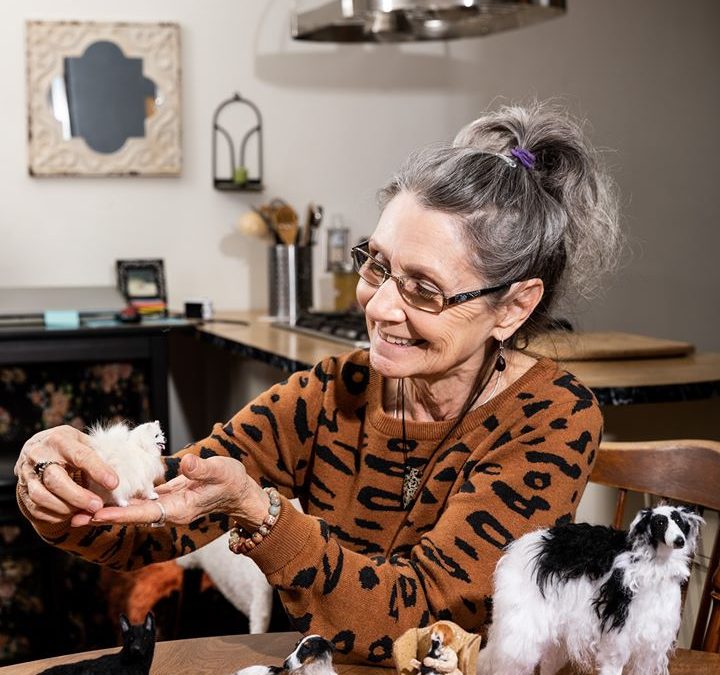
The Miniature Dogs of Lucy Francis
Ever seen five dogs lying flat on the palm of one hand? I have, on the Instagram of local artist @lucytheresafrancis (#lucysminiatures).
She holds open her hand, and on the plane of her palm rest five perfectly formed whippet hounds. Snouts tucked and snouts lifted, tails curled and tails curious—five whippets straight from some Italian count’s villa, where they were resting on their pillows. Then, suddenly, an alien ray gun shrank them small enough to carry through the world in a coat pocket! Five whippets, one hand.
I immediately found artist Lucy Francis’s website. I coldly calculated the artist’s tab for five such dogs ($300 a head, minimum) and calculated that this handful of whippets cost as much as my first car. Ever started driving one chill but bright winter morning to see an artist about tiny dogs? I have, to Hastings, to visit Lucy Francis, likely the world’s foremost creator of miniature, mostly bespoke, handmade, lifelike dogs.
Lucy Francis lives on a hill, in a low house with board-and-batten siding, near the Vermillion and Mississippi Rivers. When I arrive, I stir up quite a ruckus, led by Fred, a nine-pound rescue with the barky charm of a toy fox terrier, with his sidekick Bob, a cairn terrier given to fluffy commotions, following suit. The slight but firm Lucy Francis scoops her tiny guardians back from the thigh-high wire barrier that prevents them from roving. Taken in whole, the situation feels like a nursery rhyme: There was a little woman who lived upon a hill, with two tiny dogs and—
How wrong I was. Lucy Francis lives with at least 20 tiny dogs, and they’re much tinier than a nursery rhyme can well convey. They’re plum-sized dogs, gumball-sized dogs, stick-of-butter-sized dogs. The first thing she does is show me the Plexiglas case where she houses her back catalog. There’s Eddie, the dog from Frasier, smaller than half a cork and posed on his famed armchair. There’s a collie with flicked-out ears and a curiously tilted snout—the telltale expression of a dog that hears a beloved person in the distance, perhaps approaching the driveway.

Photo by Caitlin Abrams
Too many Scooby Snacks? Bob (a cairn terrier) comes face to face with a mystery.
An astonishing little puff of a two-inch dog sparkles at us from a little vignette carpeted with moss. “Mabel,” says Francis, seeing some unfinished flaw I cannot. “Alaskan Eskimo dog. She’s getting there.”
I mention how grateful I am to be let into Francis’s workshop, peering into a two-foot-long stage set with a ten-inch couch. There, two other dogs in progress stand, awaiting their final photo shoot.
“Oh, this isn’t my workshop,” Francis corrects me. “This is just where I keep things and photograph things.” She stoops down to open a metal chest. “I like to work out there”—she gestures toward the open-plan living room and kitchen—“with the TV and the coffee—and the dogs!”
With that, Francis lifts from the chest a 10-inch-high stack of specialty magazines: Fido Friendly, Dollhouse Miniatures, FDQ (that’s Fashion Doll Quarterly, a big glossy title not unlike Women’s Wear Daily, but featuring models who can’t age), Spain’s Miniaturas, the U.K.’s Mini-ologie, Teddy Bear Times & Friends, and many more. All feature spreads devoted to Francis’s work, which also appears in the Kentucky Gateway Museum Center. Pieces sell through the Spielzeug Welten Museum Basel, Europe’s premier toy museum, in Basel, Switzerland.
“Oh yeah, they put my youngest through college,” says Francis of the Spielzeug Welten. (Get ahead of the Swiss: LucyFrancisMiniatures.com) Francis also served as the official miniaturist of the Rin Tin Tin museum in Crockett, Texas, before it closed.
Francis flips through her pictures of famous people with their miniature dogs. Some of the celebrities who own Francis’s dogs, she says, include Shirley MacLaine, Andrew W.K., John Prine, Martha Stewart, and a member of the royal family in Qatar, whom Francis says she’s not at liberty to name. (It is likely Ahmed Al Thani, a legend for his big spending at the world’s premier miniatures show, the Kensington Dollshouse Festival.)

Photo by Caitlin Abrams
Alive? Hard to say. But we wouldn’t suggest leaving a steak on the counter.
To date, Francis has sent teeny-tiny figurines to 17 countries, including much of Europe, South Africa, and Japan. “My dogs have been lots of places I’ll never go!” she says.
As I flip through the glossy spreads, I become dissatisfied, because photography really doesn’t do justice to these miniature canines. Shot in close-up, they look merely to be photographs of dogs; pictured with a human, they lose their astonishing detail and seem mere figurines. The only way to really appreciate the life and energy in these sculptures is to get up close and turn them around and around in your hands. The muscles, the fur, the ears, the life—they look ready to run, shake hands, roll over!
While Francis makes me a cup of tea, she recounts how she learned to fabricate these models. The basic craft seems straightforward. She studies a photograph of a real dog and, when appropriate, consults breed pictures.
Next, she crafts a wire armature—the equivalent of a skeleton. This, Francis says, is the key moment: The success of the model relies on the ratios of snout to skull, leg to body, body to head. If she’s making a reclining dog, she will still start with a standing-up armature, only bending it once she’s many steps along in the process.
She wraps this wire blank in successive layers of natural fibers (alpaca yarn is a favorite). Using these fibers, Francis builds up the equivalent of muscle, fat, and sinew. To this base of wire and fiber, she adds layers and layers of additional fibers. Some of these may be commercial products; others are actual dog fur, clipped by owners who have commissioned pet look-alikes or memorial pieces.

Photo by Caitlin Abrams
Francis refers to her work as neither art nor craft. It’s “a dog thing,” she says.
Inventing and getting a hang of this process, Francis says, took eight years.
Francis made her first dog as a present topper for a fellow dog person. At that point, she was a stay-at-home mom with four kids, living in Welch, a rural town southeast of St. Paul. In 2001, Francis turned the creation of tiny dogs into a public-facing business.
Francis shows me certain markers of her progress. Dog #7 had fur that looked too large for its body. Dog #16 didn’t look real—a mere doll. Later dogs appear so perfectly muscled and furred, so curious in their expressions and alive in their eyes, that you wonder if they go places when your head is turned.
“Eight years is as long as it takes to get through medical school,” I observe.
“You’re not the first to say that about medical school.” She nods. Some dogs, she adds, are reasonably quick work, taking just a few weeks. Other dogs demand months. “But I’m not at it night and day,” Francis says. “I live my life.”
Francis’s life, in thumbnail, is this: Born in 1953 in Lilydale, she grew up with a mother who worked as a seamstress and a father who worked as a welder at American Hoist and Derrick. For fun, he bred German shorthaired pointers.
Francis remembers caring about nothing but dogs as a little kid: “As soon as I learned to talk, I begged for a dog. And everything after has just been a crazy dog thing—I just love dogs.” Francis remembers getting a Barbie doll as a kid, along with Barbie’s poodle, and thinking, “This is great and all, but it could be better.”
Nearly 25 years on, Francis says, her biggest projects tend to be memorial pieces for pets nearing their final dog years. Francis fills her days corresponding with pre-grieving dog lovers. They send digital photos, tufts of fur, and memories.
“They want to connect with someone who cares about their dog,” says Francis—not just someone collecting a check. “That’s what I like about it. I’d always rather do something meaningful. A lot of my dogs end up on urns.”
I notice a shoebox filled with individually labeled bags of dog hair. “Merlin, middle of back & sides,” read one. Or: “Maggie, butt & feathering.”
Francis says she stopped doing the big juried miniatures show in Chicago, named after its founder, Tom Bishop, because she’d rather devote herself to commission work. Though that has its pitfalls, too. “One time I made a Weimaraner for this lady in Germany, and that’s a hard dog to make. She got it; she loved it. Well, a couple weeks later, she wrote me. His brother”—that is, the deceased dog’s littermate—“ate him.” The client’s next request? “Can you make another one?”

Photo by Caitlin Abrams
As Francis leads me through her work, I can’t help but notice that she really sparks to life when she’s talking about dogs. The particulars of grooming cairn terriers. Or what Mabel, the Alaskan white puff of a dog she’s working on now, is really, really like. And there’s always the mischief of Bob and Fred underfoot.
“You seem to think of yourself more as a dog person than a fine artist?” I ask.
“Oh, absolutely,” she says, nodding her head so her high ponytail whips in echoing emphasis. “Just dog crazy. I remember my mom saying, when I was a kid, ‘Are you ever going to talk about anything except dogs?’” Francis mimics her response, as a teen with a rolled-eye expression. “Well, yeah—but what else is there?”
As the years progressed, Francis’s mom never came to terms with her daughter’s growing renown. “She would say, ‘Are you still making those little dogs?’ I’m like, Mom. I was on TV for them, twice.”
Francis doesn’t even like people to think of her little dogs as a craft. Twenty years ago, TV producers invited Francis to appear on Martha Stewart’s show. Their idea: Stewart would hand Francis an eye or something, let her work for a moment, and then they’d show the finished craft to the camera. Francis considered this proposal preposterous: to mislead viewers about how long her work takes. And the finishing touches are absolutely minute—hardly camera friendly. Francis told Martha Stewart no.
If these dogs are not fine art, and not really a craft, what are they?
“A dog thing,” Francis says firmly.
I gently suggest that the Smithsonian is chock-full of miniatures, particularly miniatures of loved ones who’ve passed on, and that Francis is carrying on a noble artistic tradition. Francis knows all this. She works with the TV on, mainly, and arts documentaries may be her favorite background noise.
Suddenly, an interruption. Squirrel! As the critter approaches the recycling bin out the window, Bob and Fred storm across the kitchen. It’s their lunchtime, Francis suggests, which renders them particularly excitable.
I make my goodbyes, and walking outside, I notice big eyes in the windows of the little house. Bob and Fred are tracking my departure.
My mind turns back to that half-imagined nursery rhyme: There was a little woman, on a little hill, making little dogs, by her windowsill. Bark a happy bark, she’s making more dogs still!

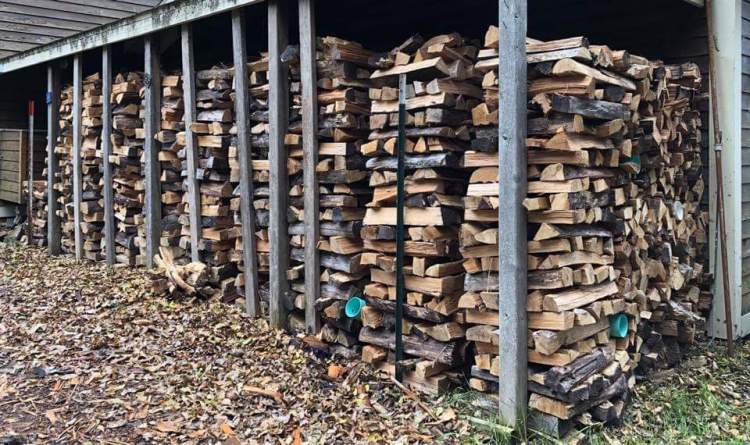
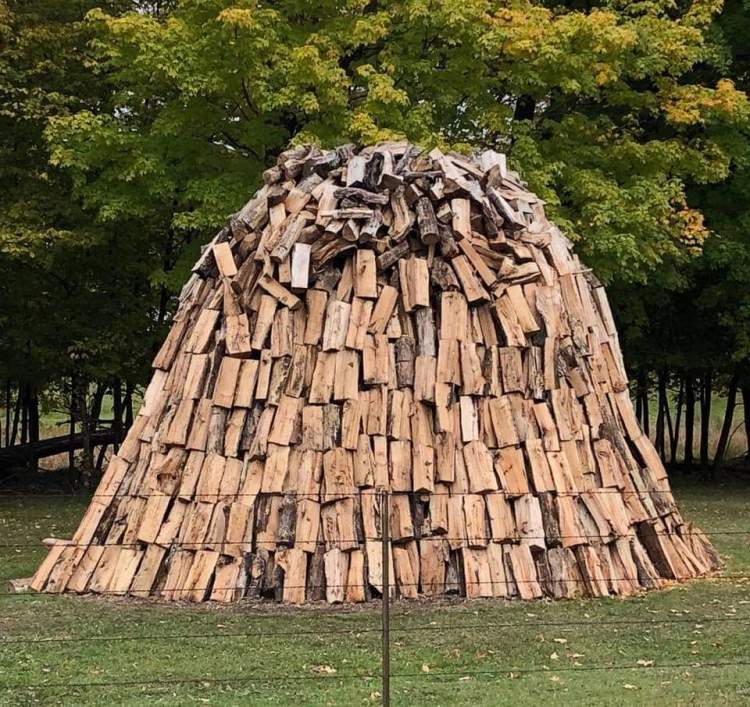
“I don’t think there are any covered bridges in Otter Tail County, but there are plenty of woodpiles. My sister Betsy and I had taken photos of the massive woodpile created during a family work weekend that included splitting and stacking wood needed for the maple syrup evaporator. Later, after we found some creative woodpiles when driving around in the area, Betsy posted photos of a couple of them on Facebook. Recently, I came across more woodpiles and thought it would be a fun blog post. Betsy gets credit for the title. Enjoy The Woodpiles of Otter Tail County.”
A few random wood piles seen out and about in Otter Tail County.